
According to recent findings in management research, whether a company is well going depends largely on whether its management team is healthy. This is not simply a matter of whether the individual members are good or bad. It also includes the question of whether there are enough of them.
A part of management capability is execution capability.
This may sound like an empty metaphor, but research that has tracked the relationships among top management, execution capability, and company performance has demonstrated precisely this structure.
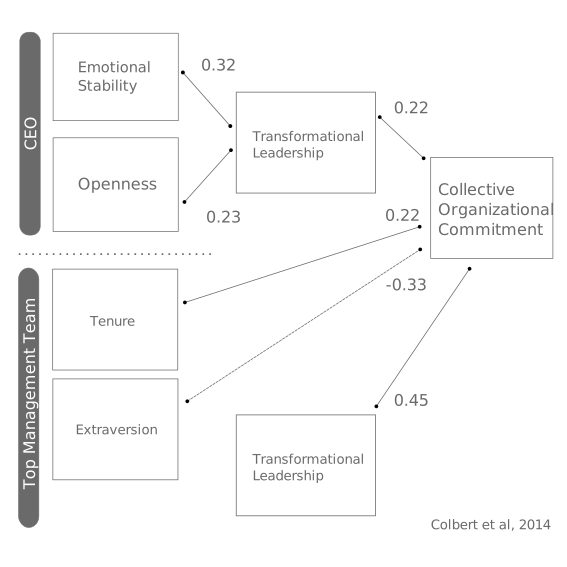
The effect spreads to collective commitment across the organization primarily through the mediating variable of transformational leadership.
Analyses of CEOs have identified effects from the Big Five traits of Openness—the personality trait associated with the breadth of associative thinking—and Emotional Stability. By contrast, clean correlations have not been extracted for the rest of the top management team, such as CxOs, because their scores are averaged across multiple people. The research also shows that higher Extraversion—the personality trait measuring activity and assertiveness—within the top management team is associated with lower organizational commitment, and that the outcome is also affected by team tenure.
The model reportedly explains 27% of organizational commitment using the CEO alone, rising to 47% when the rest of the top management team—6.4 members on average—is included1. Because not all variance in outcomes is controllable and some uncertainty inevitably remains, this is a structure in which management-team parameters control more than half of organizational behavior.
The principal component of repeatable management performance lies not in the business model but in the management team. Nor is it a skill that presupposes some particular body of required knowledge.
Qualitatively assess failures and adverse incidents
Because a very small number of executives determine a large share of a company’s execution, the health of the management team can be assessed by analyzing failures of execution.
The research described above identifies executives’ Conscientiousness—the personality trait associated with reliability and integrity—as a key factor. The important point, therefore, is to look for declining discipline on the front line. By listing incidents that have occurred inside the company—undesirable events, especially those that suggest a lack of integrity—and qualitatively rating how bad they were, it becomes possible to visualize what is missing.
Human groups appear to have an inherently disorderly nature. In departments that management communication does not reach, the natural state is for problems to occur at random. If some of the identified incidents arose without management even recognizing their warning signs, that strongly suggests that the management team is understaffed.
The essential purpose of strengthening an early-stage, one-person CEO regime by adding senior managers and building a top management team is to make the organization behave as intended.
A situation in which incidents are occurring is one level worse than merely failing to carry out intended actions. CEO decision-making is also regarded as a determinant of performance independent of execution. If the CEO and executives are exhausting their capacity merely controlling frontline departments, the management structure is still inadequate.
The top management team’s role is not limited to the executive function of controlling departments. It is also the principal forum for democratically debating company-wide decisions.
The practical rule that a growing workforce requires more senior managers and stronger teamwork can be understood as tacit knowledge naturally acquired through the need to control departments.
People sometimes say that “management is lonely,” but this is not a general truth. Rather, it indicates an unhealthy chain of command. Poor communication with managers is a selection problem and should be solved through personnel decisions.
Measure personality, and the tendencies become visible
It has become clear that a substantial part of corporate organizational behavior can be explained by the personality traits of individual members. This is a breakthrough made possible by identifying the Big Five—Conscientiousness, Emotional Stability, Openness, Extraversion, and Agreeableness—and thereby gaining a highly accurate way to describe personality.
Because personality can now be captured comprehensively, person–job fit can be designed as a set of required Big Five parameters. Observing the parameters suited to each industry and occupation has become a central theme in human-resource management.
The Big Five can be measured easily through reciprocal ratings among coworkers. Because the Big Five are the personality dimensions people perceive most readily, anyone who interacts with a person regularly can rate them. Decider became the first commercial SaaS product in the world to offer the same peer-rating form of analysis used in academic research.
It is important to interpret all five Big Five dimensions together. Exceptionally, however, Conscientiousness—the trait associated with reliability and integrity—can be isolated to discuss a universal outline.
This is because accumulated management research has established the following facts:
- There is a direct component in which the level of Conscientiousness in top management rises in proportion to stronger company performance.
- Across a wide range of occupations, Conscientiousness is the trait most strongly associated with job performance.
For company performance, the following model has been identified1.
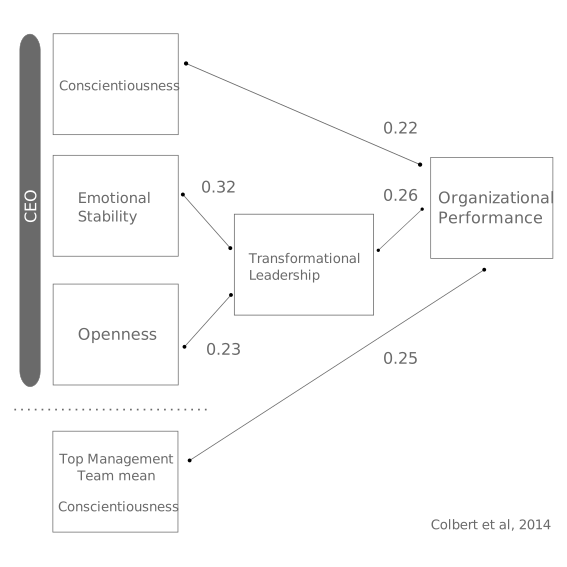
The model can be read as showing that when individual members of top management are highly conscientious, their discipline propagates to the front line and brings organizational behavior under control. A central principle of management-team composition is therefore to select highly conscientious people.
Personality is an individual attribute and changes very little over long periods. The raw material for a management team is therefore determined by the pool created at the time of hiring. You might conclude that the solution is simply to hire only highly conscientious people, but that is not realistic.
The reason becomes obvious as soon as the traits are measured: Big Five scores vary widely. Restricting hiring to the high end of Conscientiousness would make it impossible to expand headcount as desired. The other four personality dimensions also relate to job fit, so they cannot simply be discarded.
Management is the technology of securing exceptional qualities in a subset of leaders so that variation in the traits of other members can be controlled and collective action can scale. That is why it is important both to consider leadership potential at the hiring stage and to measure rigorously enough not to confuse hiring decisions with promotion decisions.
Why does higher Conscientiousness improve performance?
The fact that the personality of top management directly affects company performance has the power to rewrite the conventional understanding of business.
Even if only in part, survival in the market is determined not by what people did, but by who they are.
The conventional premise has been an indirect model: some strategy exists in the market, and the quality of that strategy affects performance. But a perspective focused on searching for the right strategy leaves a blind spot.
More specifically, research has found a fairly strong linear relationship between Conscientiousness and performance. What is happening? The detailed causal mechanisms remain for future research to explain, but the nature of Conscientiousness allows us to formulate a hypothesis.
Consider a problem with the following loss function.
| Choice | Outcome |
|---|---|
| Address the problem | Loss of 10 |
| Do not address the problem | 70% probability of a loss of 20; 30% probability of no loss |
Addressing the problem always incurs a cost of 10. Not addressing it creates the hope that no loss will occur, but in fact exposes the decision-maker to an expected loss of 14.
Given full knowledge of the mechanism, the rational choice is to address the problem. Yet as a variation of bounded rationality, people may repeatedly choose not to address it. For example, highly conscientious people may be more inclined to act because they dislike leaving the possibility of trouble unattended, whereas people low in Conscientiousness may be more inclined not to act because they wish to avoid expending the effort. This provides a coherent explanation.
The example is simplified, but the same effect applies to any function in which the expected loss from inaction exceeds the expected loss from action. Aesop’s fable The Ant and the Grasshopper is one variation of the same structure. Expected values can be compared here only because the probability and magnitude of the loss from inaction are known. In real situations, however, the probability function is unknown, making action appear merely to “reduce operational efficiency.”
This is, of course, a hypothetical model. But in an environment containing many such probabilistic loss events, the linear relationship between Conscientiousness and performance will become stronger.
An inverse model can also be constructed by replacing losses with gains.
| Choice | Outcome |
|---|---|
| Try to seize the opportunity | 30% probability of a gain of 20; 70% probability of no gain |
| Let the opportunity pass | Gain of 0 |
The parameters differ from those in the loss model, but the expected value of trying to seize the opportunity is 6, which exceeds the value of letting it pass. The two models therefore form a pair.
Because the behavioral choice in this model relates to Extraversion rather than Conscientiousness, the evidence suggests that events of this form occur less often in the real world.
The negative correlation between top-management Extraversion and organizational commitment likewise suggests that Extraversion acts as noise in company performance.
Combining these two hypothetical models gives the following picture of the real management environment:
- Events that cause losses occur in vast numbers.
- Events that create opportunities for gains are comparatively rare.
- The loss possibilities anticipated by highly conscientious people, and the actions they take in response, often capture the hidden expected-loss model well.
- The gain possibilities anticipated by highly extraverted people, and the actions they take in response, often fail to capture the hidden expected-gain model.
As explained at the outset, executives supply much of the organization’s execution capability. A nontrivial share of loss events therefore appears to arise from disorderly behavior on the front line, creating a mechanism in which the choice by executives not to act—or their inability to act—is costly in expected-value terms. The invisible hand does not tolerate careless work.
In conclusion, the principal role of top management is grounded in allocating painful losses. This insight has long been passed down in proverbial form, but the harsh reality—that executives are surrounded by innumerable sources of pain—has rarely received much attention.
The folklore of accountability
Accountability is regarded as a basic managerial responsibility. Managers are naturally expected to explain their actions in ways that superiors and stakeholders can understand.
Accountability can be treated as a rule of management, but it can also be understood as a quality derived from Conscientiousness. For highly conscientious people, principles and rules intrude strongly whenever they take action. Put differently, they are more likely to dislike actions that others cannot understand or that cannot be explained.
Highly conscientious people therefore attend to rules in every action and consider how far the action can be justified. A coherent narrative forms naturally in their minds, and they regard explaining it to others as both obvious and necessary. This is not natural behavior for everyone. To a person relatively low in Conscientiousness, it may look like an unnecessarily circuitous way of thinking. That difference is a direct effect of personality.
Management emphasizes explanation and imposes it as a rule, but individuals differ in how well they explain. Because these individual differences arise from personality, the explanations given by people low in accountability are unlikely to improve fundamentally. Thus, although accountability is formally a rule, it is not necessarily enforced in practice. Instead, differences in local custom emerge, with each person explaining only as much as they are capable of explaining.
This is consistent with the findings of management research, and the recommended course is clear. To survive business competition, a company needs highly conscientious people in management roles.
Before direct measures such as the Big Five existed, accountability was needed as a behavioral proxy. Accountability is not merely an aspirational goal that each person should pursue to the extent they can. It is a signal of the health of the management organization.
Variation in accountability is a sign that disorder is beginning to erode the organization as a whole, making it a high-priority strategic issue.